What is an RF Frequency Synthesizer and Applications Circuit Diagram A frequency synthesizer uses phase-locked loop (PLL) to generate output frequencies over a wide range. The typical range is from 1 MHz to 160 MHz. Fig: Block diagram of a frequency synthesizer. As illustrated in the block diagram above, the key components of the frequency synthesizer are: Crystal oscillator; Phase detector; Low-pass filter
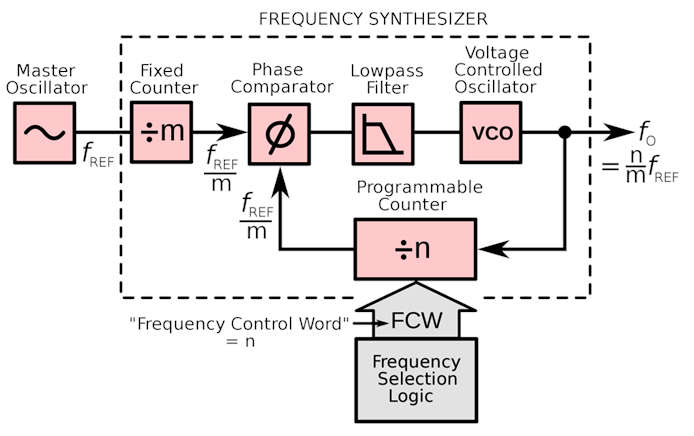
The RF frequency synthesizer design involves the integration of a Phase-Locked Loop (PLL) and a Voltage-Controlled Oscillator (VCO) to generate stable and tunable radio frequency signals. The synthesizer includes a control interface for user adjustments. RF frequency synthesizers are the cornerstone of modern communication systems, ensuring

RF Frequency Synthesizer Design: Block Diagram & Components Circuit Diagram
The Fig. 2.130 shows the Frequency Synthesizer Block Diagram. It is similar to frequency multiplier circuit except that divided by M network is added at the input of phase lock loop . The frequency of the crystal-controlled oscillator is divided by an integer factor M by divider network to produce a frequency f osc /M, where f osc is the

the design of a frequency synthesizer in a transceiver environment, from the mapping of standard-specifications to its integrated circuit implementation in a CMOS technology. The results show that careful system level planning leads to high-performance realizations of the synthesizer. A strategy of using different supply voltages to enhance The heart of this frequency synthesiser is the "Adafruit Si5351A Clock Generator Breakout Board" which can generate up to three outputs in the frequency range of 8KHz to 160MHz. The Si5351 breakout board is designed to run off 5 volts and has an I2C interface which makes it easy to connect to an Arduino.

Block Diagram of Frequency Synthesizer using PLL: Circuit Diagram
The synthesizer that we will be designing was extremely common back in the day. It's known as a 1V/Octave synthesizer. This means that for every 1V increase on the input, the output frequency will go up by one octave (i.e., by a factor of 2). Now for this module to work correctly, it needs an exponential converter on the input.
